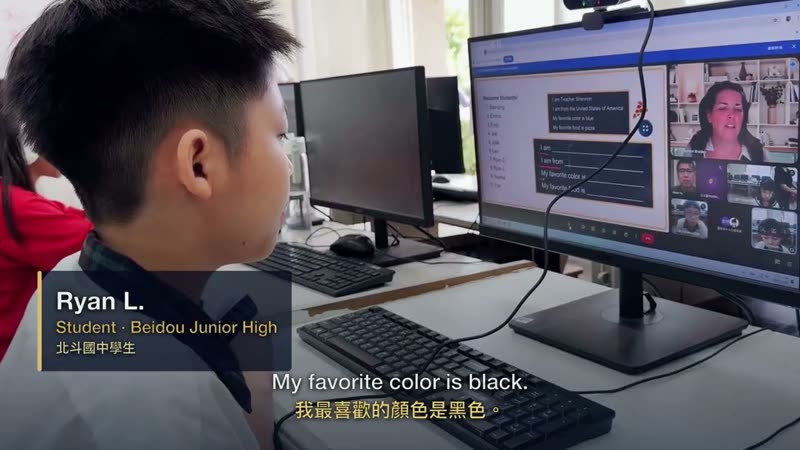
Beidou Junior High welcomed a guest speaker from Harvard University: William Gottemuller, a junior studying astronomy, who joined Class 902 by live video to share his passion — and his work — with the students.
北斗國中邀請到一位特別的來賓:就讀哈佛大學、主修天文的大三學生 William Gottemuller(威廉·戈特穆勒)。他透過視訊連線走進 902 班,與同學分享他對天文的熱情與研究工作。
He began with his own story. As a kid he loved astronomy — he used telescopes and even wrote books about the universe — though he admits he was a bit lost back then, spending most of his time playing basketball. In secondary school he joined the Milwaukee Astronomical Society, became the youngest person to be given access to its observatory, and won awards for astrophotography, a hobby that grew into a real passion.
他從自己的故事說起:小時候就熱愛天文,用望遠鏡觀星,甚至寫過關於宇宙的書;但他也坦言當時有點迷惘,大部分時間都在打籃球。中學時,他加入密爾瓦基天文學會,成為最年輕獲准使用天文台的成員,並以天文攝影獲獎——這份興趣後來發展成對天文攝影的熱情。
William showed the class his astrophotography gear and some favorite images: the Crescent Nebula, whose colors reveal hydrogen (red) and oxygen (blue) blown off a huge, hot star, and the Pillars of Creation, the star-forming region made famous by the Hubble Space Telescope. He also explained his research on gravitational lensing — a massive object bends space, so light from something behind it is “lensed” into multiple images — which astronomers use to model how the universe began, how it is changing and how it will end. One surprise from his work: there are more big galaxy clusters than expected.
William 向同學展示他的天文攝影器材與作品:新月星雲——紅色代表氫、藍色代表氧,是一顆巨大高溫恆星向外吹散的物質——以及因哈伯太空望遠鏡而聞名的恆星誕生區「創生之柱」。他也介紹自己的研究「重力透鏡」:大質量天體會讓空間彎曲,使後方天體的光形成多個影像;天文學家藉此建立宇宙模型,探究宇宙如何開始、如何變化、又將如何結束。研究中一個出乎意料的發現是:大型星系團的數量比預期還多。
His research has taken him to the Keck Telescope in Hawaii, to Taiwan — where he worked at Academia Sinica's Institute of Astronomy and Astrophysics — to stargazing and conferences in the western United States, and on to Europe.
研究也帶著他走遍各地:到夏威夷使用凱克望遠鏡、來台灣在中央研究院天文及天文物理研究所工作,也到美國西部觀星、參加研討會,足跡遠至歐洲。
He encouraged the students to get involved in astronomy, through events like the National Rocket Competition or by starting an astronomy club, and he stressed why English matters: all astronomy research is conducted in English. William learned Mandarin himself through Taiwanese bands and TV shows, so his advice was to do the same in reverse — watch English TV and listen to English music.
他鼓勵國中生參與天文活動,例如全國火箭比賽,或成立一個天文社團;他也強調學習英語的必要性——因為所有天文研究都是用英語進行的。William 自己是靠台灣樂團的歌和電視劇學中文,所以建議同學反過來,多看英文電視節目、多聽英文歌曲。
Students took the microphone to ask him questions. William shared his ultimate goal — to attend graduate school and eventually become an astronomy professor — and promised to share some of his stunning astrophotography with the class. His talk left the students inspired, and motivated to pursue their own interests in science.
同學們也拿起麥克風向他提問。William 分享他的最終目標是進入研究所,並成為天文學教授;他也承諾會跟班上同學分享一些天文攝影作品。這場分享深深啟發了學生,讓大家更有動力去追尋自己在科學領域的興趣。